

It is no secret that artificial intelligence (AI) is changing the way we work at a rate that we’ve never seen before. It is reshaping everything from the speed at which we work, how decisions are made and what expectations are set. As a result, organizations are investing heavily in technology and yet the biggest breakdown organizations are facing right now is still … human.
Until now, organizations have prioritized developing their employees on technical skills over relational ones. This would often get further reinforced when those who got promoted to leadership were the ones that were really good at their individual contributor role, inevitably creating leadership cultures built around managers who “had the answers.”
For a while, organizations got by with that. But today tells a different story. AI has fundamentally changed the game. With information and processing power accessible at our fingertips, organizations can no longer rely on technical skill sets alone.
Today, relational skills are increasingly in high demand. Learning and development (L&D) professionals know it. Executives can see it. Leaders can feel it.
In fact, World Economic Forum’s recent Future of Jobs Report lists skills like resilience, flexibility and agility, leadership and social influence, motivation and self-awareness, and empathy and active listening as some of the core skills for 2030.
Here’s the funny thing about it though, decades of research, including the work of Daniel Goleman, have consistently shown that emotional intelligence (EQ) is a critical driver of leadership effectiveness and performance. And yet, because emotional intelligence skills have historically been framed as “soft,” measurement has been inconsistent and disconnected from business metrics.
So, the data hasn’t changed. What’s changed is the environment. In the age of AI, the gap between technical and relational skills is no longer something we can afford to overlook. Therefore, it’s not that EQ lacks value, it’s that organizations lack a way to translate it into performance.
Where Leadership Breakdowns Start
Leadership challenges aren’t random. In my experience, they typically originate in one of three places:
- Capability: Do leaders have the skill set?
- Relational: Do leaders have the ability to build healthy relationships?
- Structural: Does the environment support the behavior?
When I work with organizations, I always start here because before we can measure impact, we need to understand where breakdowns originate.
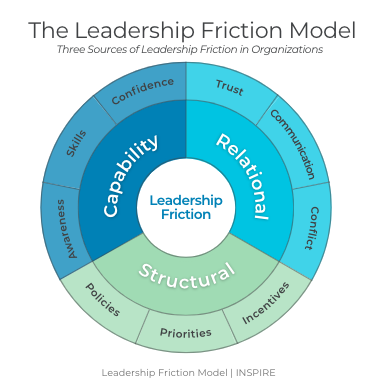
Here’s what leadership friction looks like when one or all of these are unsupported.
When a leader lacks the awareness, skills and confidence to do the role (capability), it ends with a leader who delivers poor execution and a team with poor performance. From an L&D perspective, this is often the area we are most able to spot and build training around skills gaps.
When a leader lacks the ability to build healthy relationships through trust, communication and engaging in healthy conflict (relational), you end up with a leader who is reactive or avoidant. As a result, you have a team that has low trust and high disengagement. This one can be trickier to spot, but it shows up in engagement surveys, turnover per department and you can literally feel the tension within team meetings. It’s those meetings where leaders say things like “why is everyone so quiet all the time.” The answer to their question is easy, no one trusts them but of course no one would dare tell the leader that.
When the organization’s structure has misaligned incentives (structural), you get a culture of conflicting signals, and ultimately performance drag. Because even great leaders can’t sustain change in an environment that works against them. This is the area most leadership development programming misses and why it’s so important for L&D to have a seat at the table when it comes to organization strategies.
A clear example of this is when organizations say they value collaboration, trust and strong leadership behaviors but reward individual output, speed or short-term results instead. When that happens, leaders naturally prioritize what is being rewarded even if it contradicts the behaviors the organization is trying to build. Over time, this creates confusion and reinforces the very behaviors the organization is trying to change.
What can look like a performance issue on the surface is often a signal of underlying leadership friction.
The Missing Link: From Emotional Intelligence to Business Impact
Leadership issues don’t just come from skills gaps. They come from how leaders behave, how teams function and what the organization reinforces.
Once you can diagnose where the friction is coming from, what’s missing is a way to connect human drivers to business outcomes. To bridge this gap, organizations need a clear way to translate emotional intelligence and trust into measurable business impact.
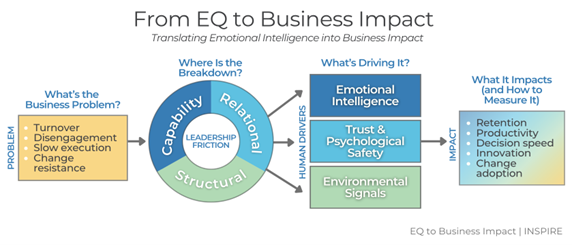
So, we’ve identified the problem through various means. It could be a spike in turnover, discovering you have low engagement from a recent employee net promoter score survey, a change is taking too long to execute or that change itself has high resistance from the employee base and isn’t sticking. Whatever the problem may be, we now know the first step is to determine where the problem is coming from (capability, relational or structural).
At this point, the question shifts from what’s wrong to what is driving it. Because once you identify where leadership friction exists, the real leverage comes from understanding what is underneath it.
In most organizations, that comes down to three things: How leaders show up (emotional intelligence), how teams function (trust and psychological safety), and what the organization reinforces (environmental signals). This is what I refer to as human drivers.
And this is the biggest breakdown organizations are facing right now. Human drivers cause most organizational problems but it is also what will be the fix. When you understand those drivers, you can connect them directly to measurable business outcomes like retention, execution and performance.
Making It Measurable: Translating Human Drivers Into Metrics
So, let’s talk about the human drivers a bit more in depth as they don’t replace where the breakdown occurs, they explain what is happening underneath them.
Emotional intelligence is how leaders show up. It’s their ability to be aware, regulate their behavior, communicate clearly and make decisions under pressure.
Trust and psychological safety are how teams function. Do people speak up? Do they challenge ideas? Do they feel safe taking risks?
And then there are environmental signals. These are the systems, incentives and expectations that shape how leaders behave regardless of their individual capability.
These aren’t separate concepts.
Emotional Intelligence is a capability that shows up relationally through trust and is either reinforced or undermined structurally.
These are the levers that ultimately shape business performance. And this is where measurement becomes possible as you are no longer trying to measure emotional intelligence as an abstract concept. You’re measuring how it shows up and what it impacts.
Each of these drivers can be measured, and more importantly, connected directly to business outcomes.
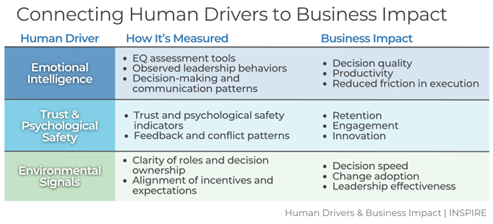
For example, when a leader can clearly see how they show up from an emotional intelligent assessment, they can now begin to shift from reacting to responding, making their decision-making quality that much better. This is especially felt in an environment of high uncertainty (which today has become constant).
When you can analyze a team’s trust score, I often use tools like the Trust Equation, you can compare the department’s trust score to their turnover and see a correlation. And when organizations have clarity of roles and ownership, you see decision speed improve.
What This Means for L&D
The role of L&D in the new era of work is shifting. We are moving out of simple program delivery and into performance enablement. This requires us to speak in business terms, to connect behaviors to outcomes, and to design systems, not just training.
In the age of AI, L&D’s value is not what it teaches but in what it enables the organization to sustain. The real risk for the future of work is if organizations continue to treat emotional intelligence skills as “soft.” If they continue to do so, they underinvest, misdiagnose issues and pay for it in turnover, disengagement and failed execution.
The question is no longer whether emotional intelligence matters. The question is whether your organization knows how to measure it, build it and reinforce it in a way that drives performance.
This is where L&D has an opportunity to lead not just as program designers but as the architects of how we connect human skills to business outcomes. That shift is exactly what this new age of work requires.