
Training professionals have long faced the challenge of helping learners retain knowledge after they leave the classroom or online training experience. Traditionally, this challenge has been framed around the idea that learners forget information rapidly over time — a concept popularized by German psychologist Hermann Ebbinghaus in 1885.
The Origins of the Forgetting Curve
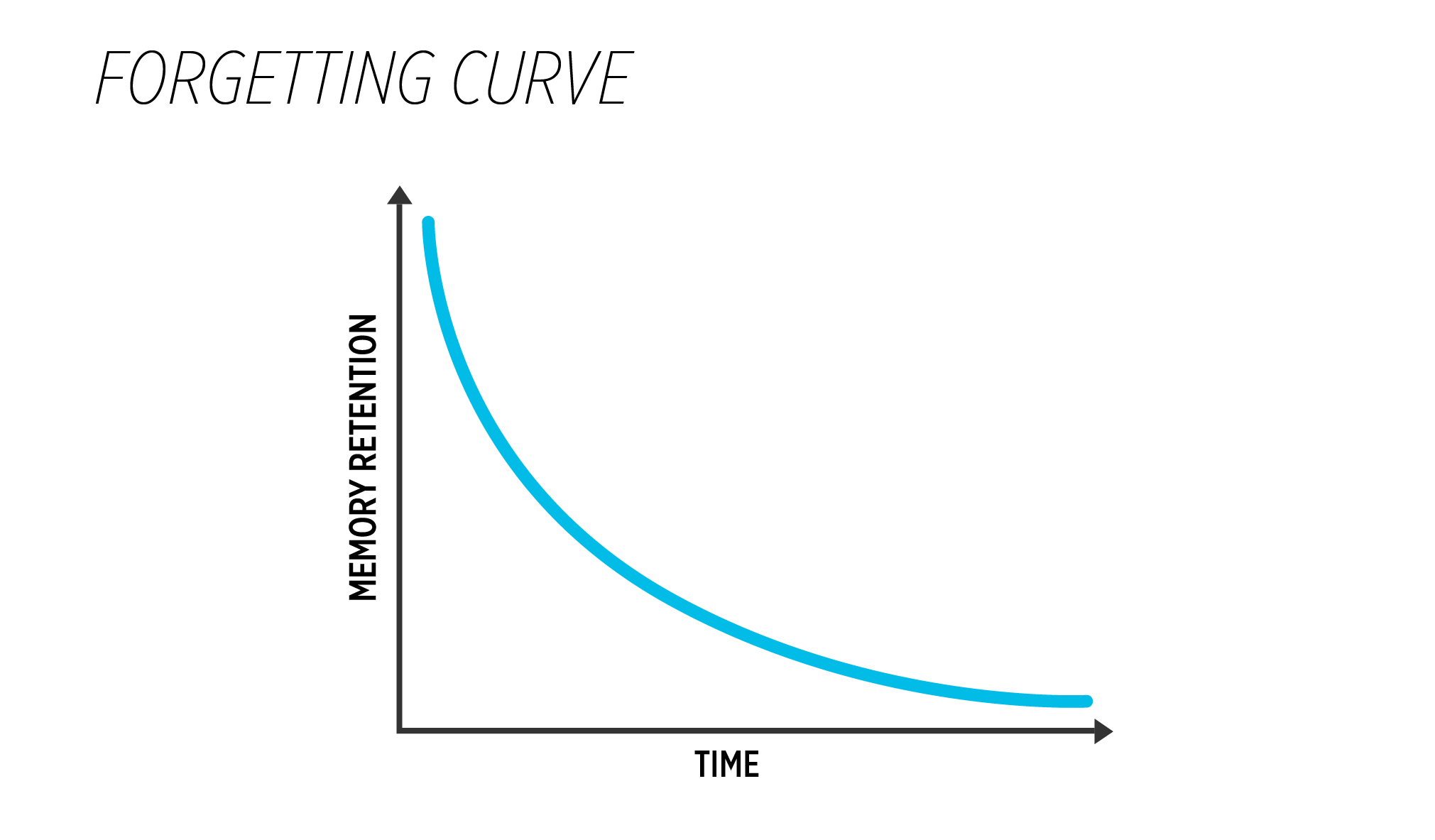
Ebbinghaus conducted experiments memorizing nonsense syllables such as “WID” and “ZOF,” testing himself at varying intervals and recording how quickly the material was forgotten. His results led to the formulation of the “forgetting curve,” which depicts memory decay over time in the absence of reinforcement. A typical representation suggests that humans may lose roughly half of newly learned information within days or weeks if not actively reviewed.
Context Matters
While the forgetting curve is often cited in corporate training as a justification for repetition and reinforcement strategies, modern research shows that memory decay is highly dependent on the type and relevance of information. Material that is meaningful, valuable or embedded in context tends to be retained much longer, even without reinforcement. In other words, context and relevance often matter more than repeated exposure alone.
Reinforcement and Memory Strength
Although reinforcement is not the only factor influencing retention, it remains highly effective when aiming to improve learning outcomes and facilitate behavioral change. Techniques such as quizzes, spaced repetition, post-training coaching, knowledge checks and follow-up webinars can strengthen memory, particularly when applied after initial learning.
Memory strength, or the durability of memory traces in the brain, also influences retention. Stronger memories persist longer and are more easily recalled. Factors affecting the speed of forgetting include the meaningfulness of material, representation methods, physiological states (stress, sleep), and mnemonic skill.
Increasing Memory Retention
Evidence-based strategies to enhance memory retention include:
- Contextualized learning: Ensuring information has real-world relevance or personal value.
- Active recall: Engaging learners in retrieving information from memory.
- Spaced repetition: Scheduling review sessions over increasingly longer intervals.
- Mnemonic techniques: Using visualizations or associations to improve memory representation.
The Memory Debate
Not all memories follow the same decay patterns. For instance, significant or emotionally charged events (so-called “flashbulb memories”) may be vividly remembered for years. However, memories are not static; they often incorporate new information and reconstruct over time, which is especially relevant in areas such as eyewitness testimony.
Ultimately, while learners may forget portions of training content, studies have found that recall of trivial or abstract information can drop sharply within days. However, the loss is not uniform. Highly relevant, meaningful or contextually anchored information can remain accessible for years. Reinforcement, therefore, is most effective when targeted and aligned with the learner’s needs and the desired behavioral outcomes.
Related Content on TrainingIndustry.com:
- Design Smarter Training: Science-Backed Strategies for Learning Retention
- The Manager’s Role in Reinforcing Learning for Greater Impact
- Podcast Episode: Learning Reinforcement — Delivering Training That “Sticks”