
Senior learning and development (L&D) leaders play a critical role in driving business performance by aligning learning strategies with organizational goals. At this level, L&D leadership extends beyond managing learning programs to influencing strategy, guiding investment decisions and driving measurable outcomes.
As the scope of the role expands, so do the expectations. Senior- and executive-level L&D leaders must bring a distinct set of capabilities that enable them to act as trusted business partners.
To help define these expectations, Training Industry developed the Training Industry’s Senior L&D Leader Competency Model™, which defines the core responsibilities required of senior- and executive-level learning leaders. The model was developed through a structured, iterative process that combined internal expertise with external validation.
7 Core Responsibilities of Senior L&D Leaders
The Senior L&D Leader Competency Model™ (Figure 1) outlines seven core responsibilities, some of which overlap with those included in the Training Manager Competency Model™. Within each responsibility are competencies that senior L&D leaders need to successfully perform the responsibility.
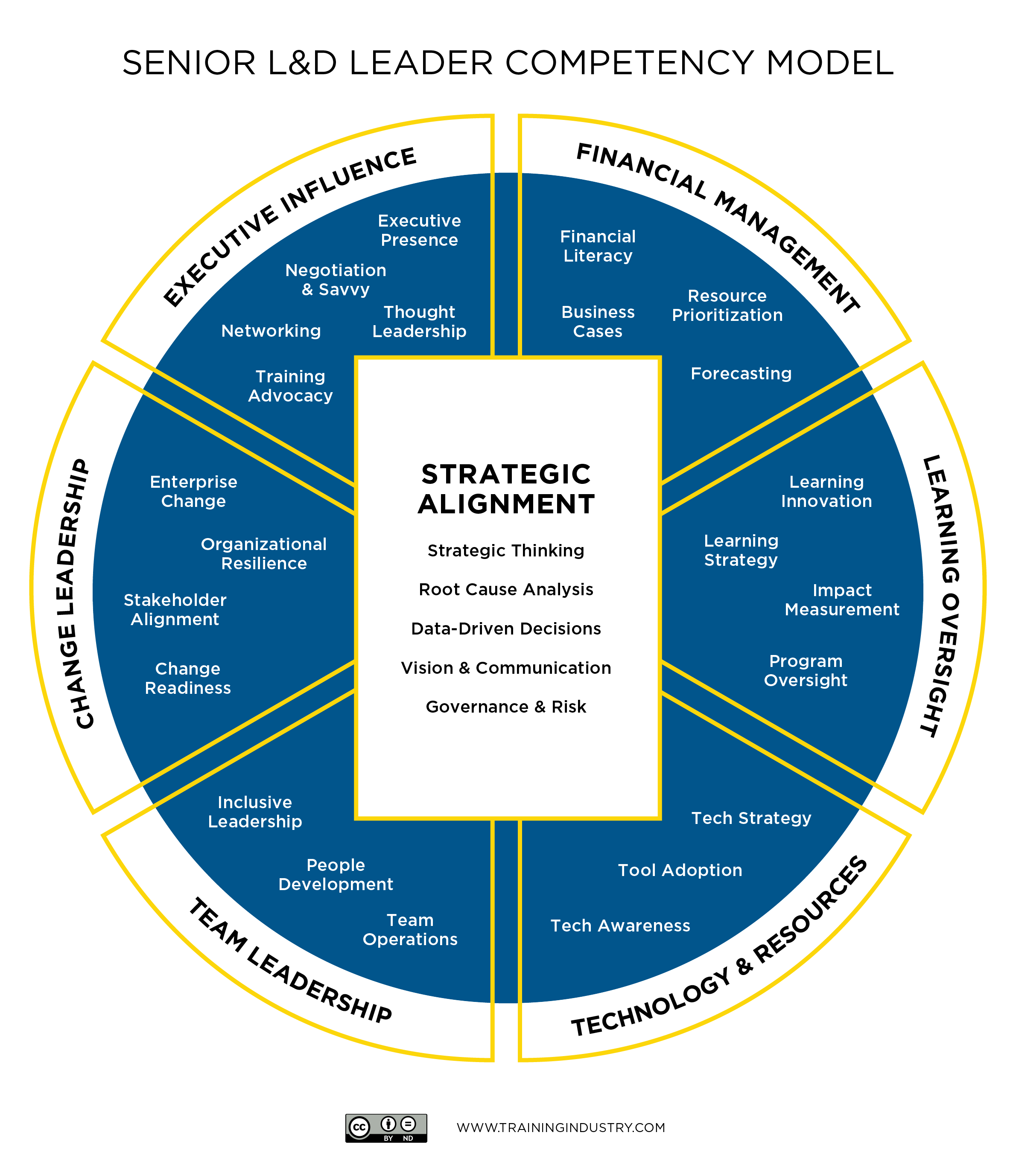
The responsibilities include:
1. Strategic Alignment
The first core responsibility is strategic alignment, which Training Industry research has found is the most important process capability of great training organizations.
Senior L&D leaders set and steward a learning strategy that aligns with enterprise goals, incorporates market foresight and balances opportunity with risk. This responsibility requires strategic thinking grounded in long-term organizational vision, as well as the ability to apply root cause analysis to determine when learning is — or isn’t — the appropriate solution to a business challenge.
Learning leaders also rely on data-informed decision making to guide planning and forecasting, while clearly articulating a compelling vision that aligns stakeholders across the organization. Underpinning these efforts is strong governance, risk and compliance ownership to ensure learning initiatives are responsibly designed for sustainable impact.
2. Executive Influence
The second core responsibility is executive influence. Senior L&D leaders build trust and credibility with stakeholders to drive strategic alignment and position the training department as a core business function. This requires strong executive presence, demonstrated through confidence and credibility in stakeholder interactions. They also use negotiation and political savvy to navigate complex organizational and external dynamics.
Executive influence also requires intentional relationship and network building across functions. In addition, senior-level learning leaders serve as thought leaders and talent advocates, establishing a visible professional brand while championing others and fostering a culture of continuous learning. In doing so, they act as ambassadors for the training function.
3. Financial Management
The third core responsibility is financial management. Responsible financial stewardship ensures learning investments are aligned with business goals and that resources are deployed in the most effective way. This requires strong financial literacy; senior L&D leaders need to interpret budgets and financial data in support of broader business objectives. They also apply business and financial forecasting, grounded in industry knowledge and business acumen, to anticipate future outcomes and prioritize initiatives with the greatest business value.
Effective resource investment and prioritization ensures financial and operational resources — including vendor contracts and partnerships — are allocated strategically. Leaders also develop compelling business cases by speaking the language of the business and grounding proposals in financial reality to secure buy-in and drive informed decision-making.
4. Learning Function Oversight
The fourth core responsibility is learning function oversight. Effective learning function oversight involves leading a high-performing learning organization rooted in evidence-based practices and measurable outcomes. This includes driving learning innovation by establishing the processes and mindset needed to pilot and scale new approaches. It also requires maintaining strong insight into learning science and professional development research to ensure the application of modern, effective practices.
Senior L&D leaders establish clear standards for performance and impact measurement, using data to evaluate effectiveness and drive continuous improvement. They also provide portfolio and program oversight, ensuring learning offerings are aligned with organizational priorities and shifting business needs.
5. Technology and Resource Management
The fifth core responsibility is technology and resource management. It includes selecting, integrating and scaling technology ecosystems that enable future-ready learning. This involves overseeing the integration of tools and platforms to ensure alignment with enterprise learning goals and existing infrastructure. It also requires leading successful implementation and adoption of new technologies through clear rollout strategies that support user engagement and sustained utilization.
A strong understanding of learning technologies is essential for senior L&D leaders, requiring ongoing awareness of emerging innovations and vendor offerings to inform strategic decisions and future investments.
6. Team Leadership
The sixth core responsibility is team leadership. Effective senior L&D leaders build and empower high-performing, inclusive teams that deliver organization-wide impact. This requires visionary and inclusive leadership that sets direction, fosters collaboration and cultivates a diverse, high-performing team culture.
This responsibility also emphasizes people development through coaching, feedback and mentorship to strengthen both individual and collective capability. In addition, effective team leadership requires establishing clear operational structures and standards that support team effectiveness and accountability.
7. Change Leadership
The seventh core responsibility is change leadership. Change leadership refers to leading, sustaining and scaling enterprise-wide change efforts. This involves leading large-scale transformation initiatives through best practices in change management and ensuring strong stakeholder engagement and alignment by securing buy-in and commitment throughout the change lifecycle.
Change leadership supports organizational resilience by fostering adaptability and ambiguity tolerance. In addition, effective change leadership requires developing change readiness capabilities across the organization by building change leadership capacity and strengthening critical skills at all levels.
The Senior L&D Leader Competency Model™ is a trademark of Training Industry, Inc. It is the foundation of the organization’s Training Industry Senior Leaders program, which is designed to help senior L&D leaders develop the skills needed to lead at the executive level.
To download a copy of Training Industry’s Senior L&D Leader Competency Model™, please fill out the form below:
Additional Resources:
- The Training Industry Senior Leaders Program
- Is the executive level is the right next step for you? Take the quiz to find out.
- The Training Industry Senior Leaders Program At-a-Glance Guide
- From Order-Taker to Trusted Partner: 10 Tips for Building Business Acumen as a Learning Leader
- CLOs Aren’t Born, They’re Built: What It Really Takes to Reach the Executive L&D Level